
TRADE $50 EARN $75!
T&Cs apply, 18+
ProphetX Prediction Market
Quick Facts
| Overall Rating | |
| Mobile Apps | iOS and Android |
| Live Betting | |
| Same Game Parlays | |
| Cryptocurrency | |
| Payment Methods | Online banking (Aeropay), Crypto (Zero Hash), Wire |
| Payout Speed | Most within 24 hours (up to 5 business days; paper check 7–14 days) |
Pros and Cons
- CFTC-licensed real money nationwide access
- Peer-to-peer exchange with no winning limits
- Low 2% commission on net winnings and 0% on parlays
- Familiar American odds interface
- Proprietary RFQ parlay engine
- Familiar American odds across moneylines and spreads as well as totals props and live markets
- 18+ (vs. 21+ at most sportsbooks)
- Liquidity depends on other traders — niche markets and props can fill slower or at wider prices
- Sports-only — no politics economics or entertainment markets like Kalshi or Polymarket
- Recently relaunched so the user base and liquidity are still building vs. larger exchanges
- Tax treatment of prediction-market profits is still unsettled — it doesn't flow like standard sportsbook winnings
- Limited funding options — online banking plus crypto and wire only (no debit cards or PayPal)
- Nationwide legality of sports event contracts is still being contested in some states and courts
HOW PROPHETX WORKS
ProphetX is an exchange, not a sportsbook. Every market is a contract on an outcome — "Yes" it happens or "No" it doesn't — and for every position you take, another user takes the opposite side. When the event settles, the winning side is paid from the pool and the losing side's stake covers it. ProphetX simply runs the marketplace and takes a small commission.
The key shift from a traditional book is who you're up against. At a sportsbook, the house sets the line, bakes in the juice, and can limit or close your account when you win consistently. On ProphetX, the price is whatever two users agree to trade at, and the platform has explicitly built around *not* restricting winners — its core marketing claim is "no limits" on successful accounts. You can take the best price currently offered, or post your own line and wait for someone to match it.
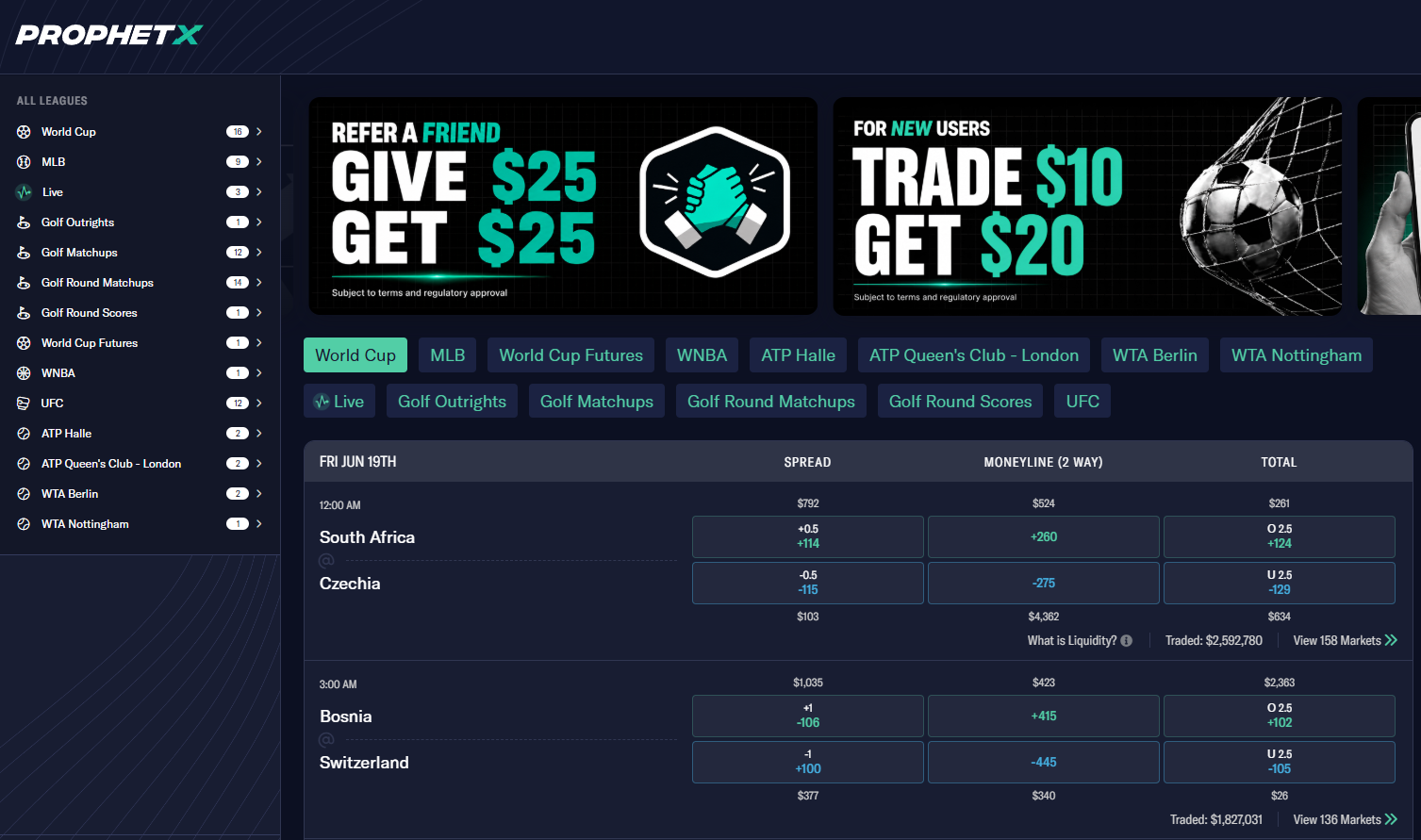
What makes ProphetX easier to use than a generalist prediction market is the presentation. Kalshi and Polymarket show contracts in cents; ProphetX shows them in American odds with the market types bettors already know — moneyline, spread, total, player props, futures, and live in-play. Under the hood it's the same regulated event-contract structure, but on screen it reads like a betting app.
MARKETS, LIQUIDITY & PRICING
ProphetX is sports-only — NFL, NBA, MLB, NHL, college football and basketball, soccer, golf, tennis, combat sports and more — with no politics or entertainment markets. That focus is deliberate: the platform is aimed squarely at sports bettors rather than the broad "trade any event" audience Kalshi and Polymarket chase.
Because pricing is peer-to-peer, the value depends on liquidity. On heavily traded markets — primetime games, major moneylines — prices are tight and you can usually beat a sportsbook's number. On thinner markets and niche props, you may see wider spreads or have to wait for a counterparty, and your fill isn't guaranteed at the price you want. This is the fundamental trade-off of any exchange: better pricing where there's volume, more friction where there isn't.
The structural advantage is real, though. A standard -110 sportsbook line carries roughly 4.5% of built-in margin. ProphetX charges a flat 2% commission on net winnings and nothing on parlays, with no vig embedded in the price itself. For volume bettors, that cost difference compounds.
FEES, PAYOUTS & GETTING PAID
ProphetX keeps the cost structure simple: a 2% commission on net winnings for straight trades, and 0% on parlays. You're only charged on what you win, not on every dollar traded.
Funding is real money. Deposits run through online banking (Aeropay), cryptocurrency (via Zero Hash), or wire, with a $10 minimum and near-instant processing. Withdrawals go back through online banking or wire, with a paper-check option, and most are processed within 24 hours — though some methods can take up to five business days, and checks 7–14 days by mail. There are no sweepstakes coins, no redemption tiers, and no playthrough gimmicks; it's a straight deposit-trade-withdraw flow like any regulated exchange.
One thing to plan for: prediction-market profits don't move through the tax system the way sportsbook winnings do, and the treatment is still unsettled. If you trade in volume, talk to a tax professional rather than assuming it works like a W-2G.
HOW PROPHETX COMPARES TO KALSHI & POLYMARKET
All three are CFTC-licensed, real-money prediction markets — the same regulatory category that lets them operate nationwide where traditional sportsbooks can't. The differences are about focus and feel:
ProphetX is sports-only and displays everything in American odds, with a proprietary peer-to-peer parlay builder and a "no limits on winners" stance. It's the most sportsbook-like of the three to actually use, and the cheapest on parlays.
Kalshi is the largest and broadest — sports plus politics, economics, and culture — shown in cents on an order-book exchange. Deepest liquidity, but a more finance-style interface.
Polymarket is also broad and originally crypto-native; its US product runs on a CFTC-licensed entity it acquired, with trading collateralized in a stablecoin. Strong on politics and global events.
If you want a prediction market that looks and behaves like a sports betting app — and you mostly care about sports — ProphetX is the most natural fit. If you want the deepest markets across every category, Kalshi and Polymarket are bigger. The honest caveat for all three: this is a young, fast-moving regulatory space, and the nationwide legality of sports event contracts is still being litigated in places.
ProphetX Customer Support Info
Live Chat Hours
Via in-app / website request
Phone Number
None
Email Address
Support request form on website / help center
Languages
English
@PlayProphetX